This is the third in a series of posts which, when completed, will bring us an in-depth look from the very earliest history – and sword history – of Japan, to the modern day, and how the world of Touken Ranbu fits into this history.
The Asuka Era (645-710 CE)
The Asuka Era saw writing introduced from China and Korea, and thus Japan transitioned from pre-history into recorded history. Due to this record keeping, standardisation of measurements as well as a centralised government began to develop.
By this point the sword had a long history, and had entered into the Japanese consciousness, with legends now formed around them. For example, one of the most precious metal objects collectively known by this era is a sword with seven branches that is owned by the Isonokami Shrine in Nara Prefecture, and bears the date of 369CE. This is clearly a sword made for ceremonial, not military, use. It was said to have been a gift from King Geunchogo of Baekje, one of the “three kingdoms” that shared the Korean Peninsular. It has been linked to the semi-legendary figure Jingu. She is said to be representative of the authentic, female, shamanistic leaders. It is also associated with a war that ensured the succession of her son, Emperor Ojin, considered the first Emperor of the Kofun era.
During the Asuka Era, the sword continued to be considered more as an item of ritual than a weapon to be used on the battlefield. Generally, the weapons used for war were mainly spears, and bows and arrows. This meant that despite the lore and traditions associated with swords, the Samurai were, for many centuries, predominantly mounted archers. This is borne out in the contemporary artwork produced about Samurai. No illustrations of mounted warriors armed with swords are found extant in surviving artwork up until the 13th century.
Swords designed for battle have been found in Kofun (burial mounds) dating all the way until the end of the Asuka era. The main distinction between Kofun era and Asuka era onwards is the shape. During this era, five sword making traditions were born, known as the Gokaden schools. These schools were:
- Yamatoden from Nara prefecture
- Yamashiroden from Kyoto prefecture
- Bizenden from Okayama prefecutre
- Shoshuden from the Kanagawa prefecture
- Minoden from Gifu prefecture.
Whilst each of these traditions were unique, there was also sharing of techniques as metallurgy and other skills continued to develop. It is also during this era that Buddhism came to Japan, which significantly changed Japanese culture and society.
Unlike Shinto, Buddhism introduced the idea of anthropormorphic deities. It was during this era that the Soga clan rose to be one of the powerful, aristocratic clans, who played a major role in the the dissemination of Buddhism throughout Japan. Unlike many clans who were focused on military or religious purposees, they prioritised the mastering of continental knowledge acquired from commercial and diplomatic exchanges. As such they built an intellectual elite, allowing them to introduce a Chinese inspired administration system. This led to them becoming both important and trustworthy counsellors in the management of the affairs of the Yamamoto Kingdom’s affairs. The Yamamoto Kingdom, conventionally considered to have existed from about 250-710CE, is most noted due to the Imperial kingdom being ruled from the Yamamoto Province of the Nara prefecture. Unfortunately for the Soga clan, their continental connections were seen by more traditional clans as a threat. These tensions peaked as the Soga clan started publicly endorsing the adoption of Buddhism. As a foreign doctrine, many of the clans believed it was incompatible with Shinto and other indigenous beliefs. Due to this, several conflicts, ostensibly for religious reasons, sought to lessen the Soga clan’s influence over the court. Despite this, the clan defeated many of their opponents and therefore further strengthened their political position.
During this time there was also a shift in the culture of the Shinto religion, most notably the transition from Shinto gods being linked to sacred objects, like mirrors and swords, to anthropomorphic images. Despite this, those representations were hidden in the inner sanctuaries of Shinto shrines.
During this era the sword continued to be linked with the religious and spiritual fabric of Japanese consciousness. At this point in time it is certain that the continuous evolution of the sword had lasted for over 1000 years. Despite this, it is still unknown to what extent the Japanese used swords as either tools or weapons.
The oldest of the swords linked to this era date back to the fifth and sixth centuries, and they had straight and narrow hamon. The hamon is created by cooling the blade at different rates, achieved by the use of clay, in order to create two types of steel with different properties. This was necessary in order to create a hardened edge that would hold its sharpening, and a more flexible back of the blade which prevented the sword from shattering. Originally these hamon were straight, and would often split into two pieces rendering it useless on the battlefield. This meant the hamon quickly developed into a more elaborate undulating design. These more complex designs of semicircles and waves allowed for a larger surface area of the two distinct sides of the blade to be in contact, and created a join that was almost zip-like in shape. This hamon is among the most prominent aspects unique to the Japanese sword.
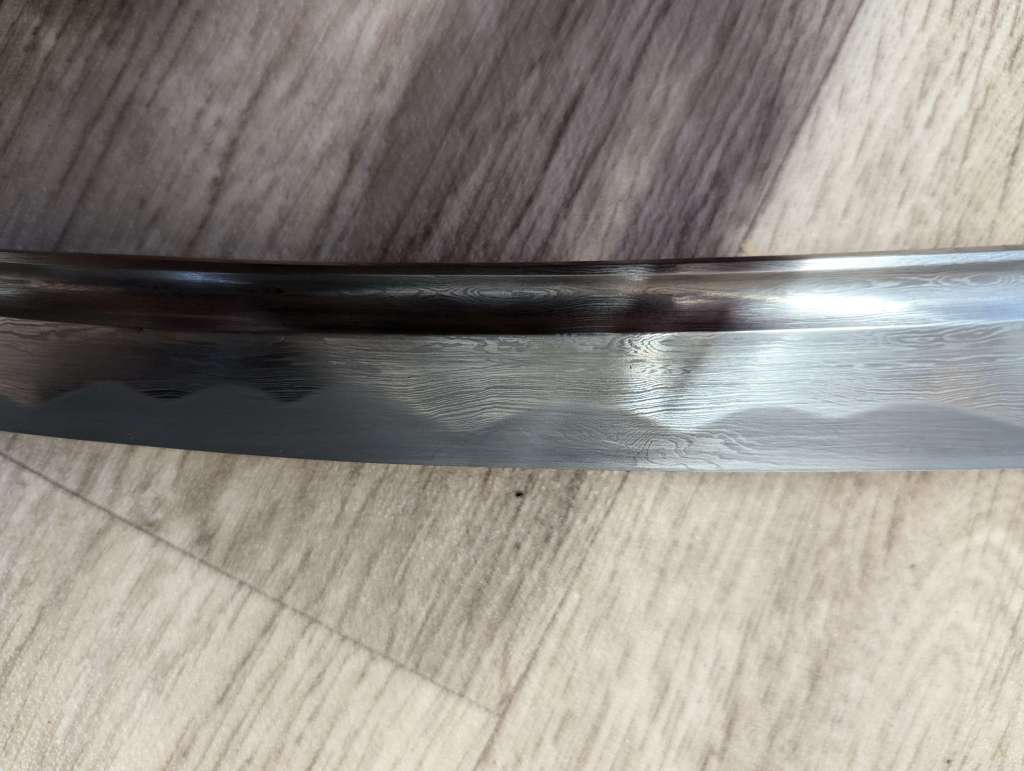
The hamon of a modern sword, made in the traditional manner, showing the pattern of the hamon.
In this era, the Chukoto (or Sokoto) continued to be made; they remained of importance, being forged up to at least the tenth or eleventh centuries.
Later blades were called Kiriha-Zukuri, a name that translates to “cutting edge” or “chop off” style, referring to the curve of the blade. These blades allowed for powerful cuts and thrusts, thus making them useful weapons on the battlefield. They have flat, parallel sides with a large ridge line, very close to the cutting edge. These flat sides taper down to the cutting edge making the angle of the cutting edge obtuse (an angle greater than 90°). These swords characterised swords forged in Japan all the way up to the 8th century.
Whilst swords of this time are still a rare find, the specimens that exist allow us to track the evolution of swords for almost two milliania.
One of the major turning points that lead us from the Asuka era into the Nara era are the institution of the Taika Reforms, as codified in the Taiho Codes (701-703CE), with Emperor Genji claiming ownership over all the land of the Japanese islands. During the Nara era the oldest of the Touken Danshi began to be forged.
 Astroninjagirl Subtitles
Leave a comment